

Collectivist Culture + Mental Health + Grief
In every family, there are unspoken rules for how one should show up, act, and behave. Familial invalidation is what can happen after a build-up of dismissal, rejection, or negation of an individual's thoughts, feelings, or experiences within your family or cultural unit. When you are in a collectivist culture where it doesn’t feel safe to be your true self, this invalidation can manifest in many forms, including overt criticism, belittlement, or the subtle denial of emotions. Over time, persistent invalidation can erode self-esteem and contribute to emotional distress, impacting mental health. Through the lens of collectivist culture, familial invalidation may feel not only as a rejection of individual experiences but also as a departure from collective expectations and family that could umbrella into many areas of your life.
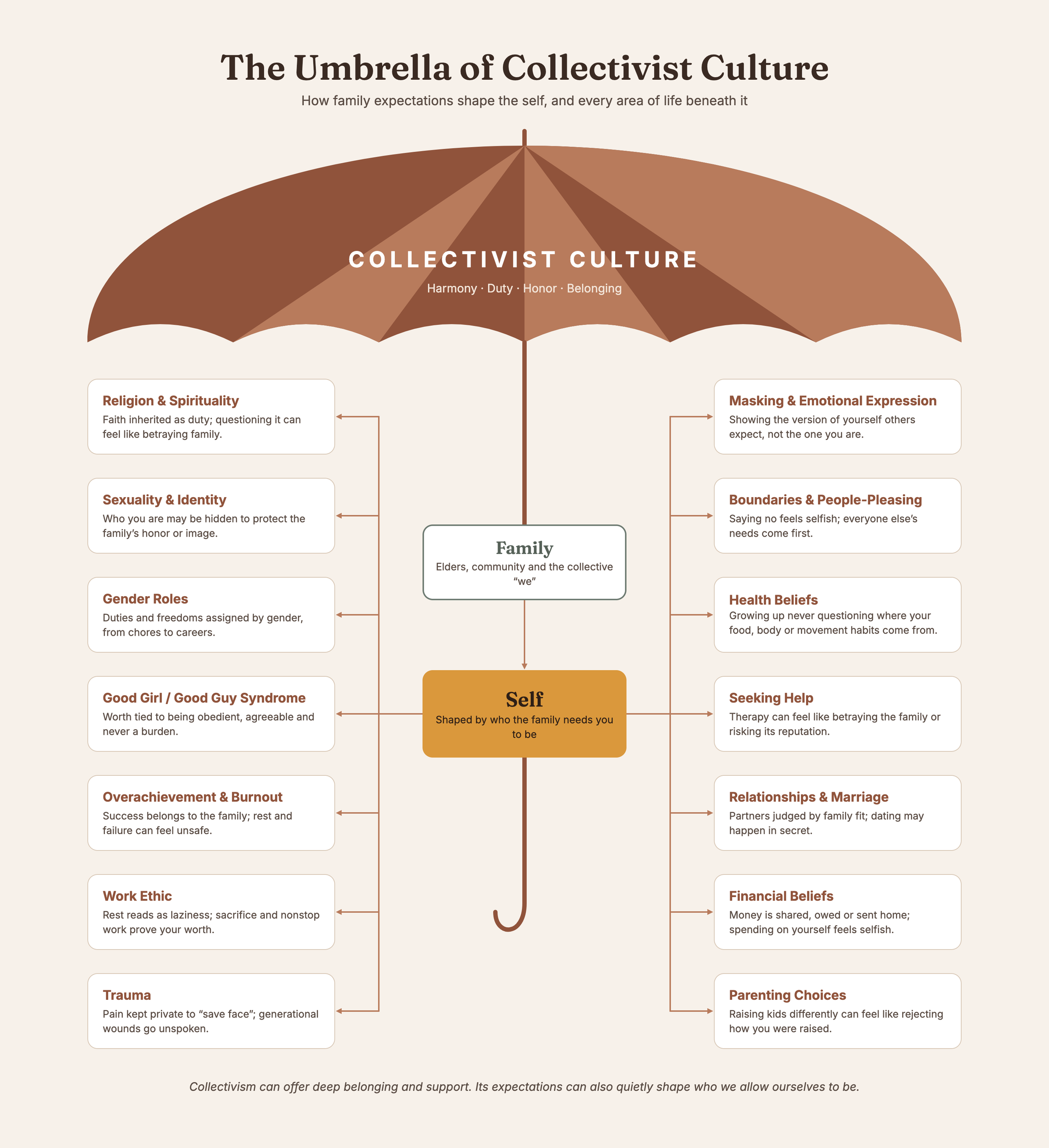
In my work with people navigating collectivist family systems, grief comes up more often than almost anything else. We usually think of grief as what happens when someone dies. But grief shows up any time your life changes in a way that matters, and stepping outside the role your family and culture shaped for you changes everything.
Setting boundaries or choosing your own path can cost you closeness with family, your place in a community, sometimes relationships you thought would always be there. Even when you stay connected, things shift. You may see your parents differently than you once did. A relationship with a sibling or relative may never feel quite the same. You may lose the future you were raised to expect: the career, the marriage, the version of yourself that would have made everyone proud.
And then there’s the part that’s harder to explain: missing things you don’t even want anymore.
You miss knowing exactly where you fit. You miss believing that if you were good enough, obedient enough and successful enough, you’d be loved and safe. You miss being the responsible one, the one everyone counted on. You miss the pride of being good at a role that once meant everything and now means something different.
Some of what you miss may be harder to admit, even to yourself. The approval. Never having to choose for yourself. Being needed.
If any of this sounds familiar, there is nothing wrong with you. We only grieve what mattered to us. Missing something doesn’t mean you want it back. Your family and culture can give you belonging, identity and purpose, and some of those same things can still have hurt you. Both can be true, and you’re allowed to grieve it all.
In collectivist cultures, there may be a prevailing stigma surrounding mental health issues, further complicating the process of seeking help. Individuals grappling with familial invalidation may hesitate to reach out for therapy due to concerns about familial reputation or fear of being perceived as deviating from cultural norms.
It’s okay to live a different life from your family, it doesn’t mean you’re bad or less of a person, it means you have the courage to discover what you want. If you're interested in working through some of these experiences and wondering whether we might be a good fit, I'd be happy to talk with you about what you're looking for in therapy.